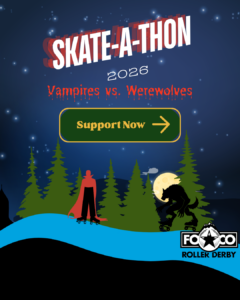
On March 2, 2026, the skaters of Foco Roller Derby will participate in the Skate-A-Thon. Skate-A-Thon is an annual event for FCRD and one of our most important fundraisers of the year, where skaters dress in opposing team costumes and participate in a two hour skating marathon. This year pits Team Werewolf against Team Vampire. While this annual event provides FCRD skaters with a fun opportunity to test their speed and endurance in a rare contact-free environment, it is also a tradition that hearkens back to the origins of our beloved sport.
Long before the full-contact sport we know today, the popularity of roller skating and marathon endurance events culminated in the rise of roller skating endurance races in the late 1800s. In 1885, Madison Square Garden hosted a six-day roller skating endurance race, in which individual competitors skated for twelve or more hours per day. By the end of the race, winner Jonathon Donavan and three other competitors had rounded the track over 8,000 times to log over 1,000 miles of skating, with Donavan ringing in with a final distance of 1,092 miles and winning the $500 cash prize (1). Sadly, both Donavan and one other skater would die only days after the conclusion of the competition from complications of overexertion, sparking debate about the safety and morality of such extended endurance races (2, 3).
The term “derby” indicating a race or mutli-race event was used to describe these competitions as early as 1922 (4).
Amidst another surge in the popularity of roller skating during the 1930s, Leo Seltzer, formerly an organizer of other endurance events such as dance marathons and walkathons organized the first Transcontinental Roller Derby in 1935. Hosted at the Chicago Coliseum, the event featured 25 two-person teams of skaters who competed in a simulated race to cover the 3,000 mile distance between Los Angeles and New York City. While skaters circled the rink for up to 11.5 hours per day for over a month, a large map tracked their simulated distance across the country. Over the course of the race, sixteen teams dropped out due to injury or exhaustion, with only nine of the original 25 teams managing to complete the 3,000 mile race (5). The Transcontinental Roller Derby persisted through the 1930s and early 40s, drawing daily crowds of 10,000 or more spectators (5, 6). Though these races were billed as non-contact sports events, the number, speed, and competitive spirit of the skaters involved sometimes led to spectacular hits, collisions, and falls. While Seltzer initially resented this as detracting from the legitimacy of the sporting event, he was eventually persuaded by sportswriter Damon Runyon to rework the rules and lean into this aspect of the sport which fans found particularly exciting (7). Over time and many different iterations, this evolved into the two-team full-contact sport we know and love as roller derby today.
In 2026, the modern FCRD Skate-A-Thon places a strong emphasis on skater health and safety and runs for only two hours, rather than for multiple days or weeks. Nevertheless, skaters who put their all into the event can still achieve impressive feats of speed and endurance, with some skaters skating 10 or more miles around the derby track over the course of two hours.
This year’s Skate-A-Thon pits Team Werewolf against Team Vampire for an exciting and fun-filled night of skating. You can support your favorite supernatural skaters in their Skate-A-Thon endeavor by making a flat-rate donation, or you can lean into this bit of derby history and encourage skaters to push their speed and endurance by making a per-lap donation. The funds raised in Skate-A-Thon help support league operations, hardship funds, a library of loaner gear for new skaters, and much more.
Citations:
- “Over a Thousand Miles”. Brooklyn Eagle. 1885-03-08.
- “Victim of roller skates: death of Donovan, winner of the last tournament”. The New York Times. 1885-04-11. p. 5.
- “Killed by roller skating: death of one of the contestants in the Madison-Square race”. The New York Times. 1885-03-18. p. 5.
- “Von Hof first in ten mile roller derby”. Chicago Daily Tribune. 1922-12-01. p. 21.
- “Roller Derby at the National Museum of Roller Skating”. National Roller Skating Museum. 2004.
- “Roller Derby”. TIME. 1936-02-03.
- Rasmussen, Cecilia. “L.A. Then and Now: The Man Who Got Roller Derby Rolling Along”. Los Angeles Times. 1999-02-21.